Pause and regulate.
Try one complete session.
A practical starting point for counselors working with adults: notice an early cue, plan a safe pause, and practice a grounding option that fits.
Free to download. No email signup required. US Letter · Printable PDF · Not fillable.
An actual handout from the sample. Two illustrated pages are included alongside the facilitator guide and worksheets.
A session you can open,
adapt, and try.
- Who it is for
- Counselors and therapists working with adults
- Session length
- 90-minute group; 50-minute individual adaptation
- What you receive
- One PDF, 10 pages
- Format
- US Letter, portrait; printable, not fillable
Inside the sample
- A timed facilitator guide with suggested wording, rehearsal, processing questions, and homework.
- A safe pause plan and coping skills experiment worksheet.
- Two illustrated teaching aids: Pause Before the Pattern and Build Your Coping Menu.
- A reusable practice log and an optional counselor feedback form.
- Safety guidance and optional substance use treatment connections.
This is Session 4 from the developing eight-session Breaking the Bond with Anger collection. It is available here as a free review sample.
Before you lead the session
Read the safety page and full facilitator guide. Choose a mild fictional example, provide the two worksheets, and offer passing or observation. Adapt within your training, scope, and setting procedures. Grounding is optional; stop or change an exercise that increases distress.
These original educational materials are not a validated treatment protocol, crisis response, violence intervention, or certification course. They do not establish a counseling relationship or replace individualized assessment and care.
Use and sharing
You may print the sample for your own professional sessions with your own clients. Please share this webpage link rather than redistributing the PDF. No resale, public file posting, or template sharing.
Tried it? Help us make it more useful.
Tell us what was clear, what took extra preparation, and what you changed. The feedback form on page 10 is optional. Please do not send client names, identifying examples, or health records.
Send resource feedback ↗Prepared for Kayla Bond, LCDC. Review sample with AI-assisted drafting and AI-generated illustrations.
Explore more anger-management resources ↗Read the text version of the session
PAGE 1
FREE COUNSELOR SAMPLE
Pause and regulate
A complete anger-management session from Breaking the Bond with Anger
BREAKING THE BOND  |  ANGER MANAGEMENT  |  REVIEW EDITION 1.0
1
FOR COUNSELORS WORKING WITH ADULTS
Try a structured session for noticing an early cue, planning a safe pause, and choosing a
tolerable grounding skill.
What is included
• Page 2: safety guidance and group agreements.
• Pages 3-4: 90-minute facilitator guide with a 50-minute individual adaptation.
• Pages 5-6: safe pause plan and coping skills experiment worksheets.
• Pages 7-8: two illustrated visual handouts.
• Page 9: weekly practice log. Page 10: optional counselor feedback form.
Use the sample thoughtfully
Read the safety page before use. Work within your training and setting requirements. Use mild
fictional examples, offer passing, and adapt for access needs. These educational resources are
not a validated treatment protocol or a substitute for individualized care.
Free sample permission
Download and print for your own professional sessions with your own clients. Do not resell,
publicly redistribute the PDF, or share templates. You may share the webpage link so others can
download their own copy.
Optional feedback
If you try the session, we welcome practical feedback about clarity, preparation time, and what
you changed. Use the contact link on the sample webpage. Please do not send client names,
identifying stories, or health records.
Prepared for Kayla Bond, LCDC | October 2026
Review sample - original material with AI-assisted drafting and AI-generated illustrations.


PAGE 2
START HERE
Safety and group agreements
Group agreement to read together
OPENING AGREEMENT
Speak about your own behavior. No threats, insults, intimidation, unwanted contact, or
demonstrations of aggression. Share time. Do not name other people. Passing is allowed.
Ask for a pause early. Respect others' privacy; group confidentiality cannot be guaranteed.
The facilitator will explain its limits and safety responsibilities.
During escalation
Stop the exercise and use a calm, direct voice. Reduce the audience and demands when feasible.
Offer space and choices consistent with setting policy. Do not process blame, force eye contact,
or insist on role-play while someone is escalating. Seek staff or emergency support for immediate
danger, and follow organizational procedures.
When a different response is needed
Threats, stalking, coercive control, intimate-partner violence, serious aggression, acute
intoxication or withdrawal, or severe psychiatric instability require individualized assessment and
appropriate specialist care. A general anger group is not a substitute for a violence intervention
or crisis response. Do not assign joint confrontation, mediation, or couples exercises where
coercion or fear is present.
Choice and consent
Use low-intensity scenarios rather than reenactments of violence. Do not require closing eyes,
disclosing trauma, practicing with an unsafe person, or delivering an apology. A pause or repair
plan must respect unwanted-contact limits, protective restrictions, and the other person's choice.
Return to a conversation only when appropriate and safe.
Facilitator redirect
WHEN SAFETY COMES FIRST
I hear how strong the feeling is. We are stopping this practice now. Let us focus on space,
support, and the next safe action. We can review the pattern later.
BREAKING THE BOND | COUNSELOR SAMPLE | REVIEW DRAFT
2


PAGE 3
FACILITATOR | SESSION 4
Pause and regulate
90 minutes | Materials: W7, W8, pens, timer, optional board
Observable objectives
• Demonstrate two regulation options without forcing breath work.
• State a pause request with a safe destination and follow-up plan.
• Identify one strategy to avoid during escalation.
0-10 min | Check in and reconnect
Ask for a current rating and one practice attempt since the last session. Invite one thing that helped
and one barrier. Offer passing; reinforce effort and accountability without ranking participants.
10-25 min | Teach the core idea
A pause is a purposeful interruption that reduces the chance of harm. It is different from disappearing
to punish someone. Agree on safe space and a follow-up when appropriate. Regulation options include
orienting to the room, feeling supported by the chair, gentle movement, and comfortable slower
breathing. Choose what is tolerable; stop an exercise that causes distress or dizziness.
TRY SAYING
You do not need to feel perfectly calm before you can act responsibly. The first goal is
enough space to avoid harm. You can keep your eyes open, observe, or use a different
grounding option.
25-40 min | Model before asking for disclosure
Lead three brief trials: name three neutral objects in the room; press feet gently into the floor or notice
chair support; take several comfortable breaths without breath holds. After each, ask what changed or
did not change. Movement should be optional and accessible.
40-60 min | Guided worksheet practice
Complete W7 and W8. Use a mildly frustrating scenario. Each person practices a pause statement,
names a safe destination, chooses a skill, and rehearses a return or check-in. In residential settings,
align the destination and contact person with program rules.
BREAKING THE BOND | COUNSELOR SAMPLE | REVIEW DRAFT
3


PAGE 4
FACILITATOR | SESSION 4 CONTINUED
Practice, process, and follow through
60-80 min | Rehearse and process
Spend about 10 minutes rehearsing the skill with a low-intensity example and 10 minutes processing.
Coach one change at a time, repeat once, and invite a volunteer or private reflection. Use these
prompts:
• Which option felt usable rather than merely familiar?
• How will you communicate a pause without blaming or threatening?
• If you are not ready to return, how will you check in safely?
Worked example
"I am getting too activated to talk respectfully. I am taking a pause in the courtyard. I will check in at
4:30 if it is safe." During the pause: no hostile messages, substance use, or rehearsing retaliation. If
the situation is unsafe, prioritize separation and support rather than return.
80-90 min | Homework and closing
Practice one regulation option once per day on five days, including when calm. Record before/after
anger ratings and usefulness. Rehearse the pause statement twice when safe.
Ask each participant to name one next step and check readiness to leave. Offer an individual check-in
if activation remains high. Confirm where to seek support and when the next session occurs.
If participants get stuck
If grounding increases distress, stop. Offer eyes-open orientation, a neutral conversation, or quiet
observation. Do not insist that one technique works for everyone.
Individual-session adaptation
Individual format: 5-minute check-in, 10-minute skill menu, 15-minute trials, 15-minute pause
rehearsal, 5-minute plan. Review accessibility, pain, sensory preferences, and whether privacy is
available.
Optional recovery connection
Pair the pause with a recovery support contact if anger and craving rise together. Choose a location
without easy access to substances when feasible. Use the person's existing treatment plan.
Observe before moving on
Can the participant state and rehearse a safe, specific pause with a backup option?
BREAKING THE BOND | COUNSELOR SAMPLE | REVIEW DRAFT
4


PAGE 5
CLIENT WORKSHEET | W7
My safe pause plan
Session 4 | Adapt this to your setting and any individual safety plan.
Name or initials: _______________________ Date: ______________
My early cue and the words I will use to request a pause:
My safe location and any program rules or access needs:
Two things I can do during the pause that reduce harm:
If appropriate and safe: when and how I will check in or return:
If I cannot return safely or my first plan fails: support and backup:
BREAKING THE BOND | COUNSELOR SAMPLE | REVIEW DRAFT
5


PAGE 6
CLIENT WORKSHEET | W8
Coping skills experiment
Session 4 | Try a tolerable option. Stop if it increases distress.
Name or initials: _______________________ Date: ______________
Trial 1 - Skill, situation, rating before/after, and what I noticed:
Trial 2 - Skill, situation, rating before/after, and what I noticed:
Trial 3 - Skill, situation, rating before/after, and what I noticed:
Most usable option and when I will practice it next:
BREAKING THE BOND | COUNSELOR SAMPLE | REVIEW DRAFT
6


PAGE 9
PRACTICE TOOL | P3
Weekly skill practice
Notice practice and impact rather than aiming for perfection.
Skill I am practicing and the cue that will remind me:
Practice 1 - Date, situation, what I tried, and what happened:
Practice 2 - Date, situation, what I tried, and what happened:
Practice 3 - Date, situation, what I tried, and what happened:
What helped? What will I adjust next week?
BREAKING THE BOND | COUNSELOR SAMPLE | REVIEW DRAFT
9


PAGE 10
COUNSELOR FEEDBACK
Help make this easier to use
Pause and regulate | No client-identifying information, please.
Reviewer name or code (optional): ______________ Date: __________
Setting: ______________ Reviewed only / Tried individually / Tried with a group
Preparation time in minutes; total session time; materials you added:
Rate your experience
1 = poor; 2 = needs work; 3 = adequate; 4 = good; 5 = excellent. Use N/A if not tried.
Instructions were clear. 1 2 3 4 5 N/A
The session was practical to deliver. 1 2 3 4 5 N/A
The worksheets were understandable. 1 2 3 4 5 N/A
The visuals supported learning. 1 2 3 4 5 N/A
The allotted time was realistic. 1 2 3 4 5 N/A
What did you need to explain, change, or create yourself?
Would you use this again? Why? What is the most important change?
Would you pay for a single-session kit or full series? At what price, and why?
Optional follow-up permission: You may contact me for clarification: Yes / No
This form does not grant permission to publish my name, comments, or a testimonial.
BREAKING THE BOND | COUNSELOR SAMPLE | REVIEW DRAFT
10


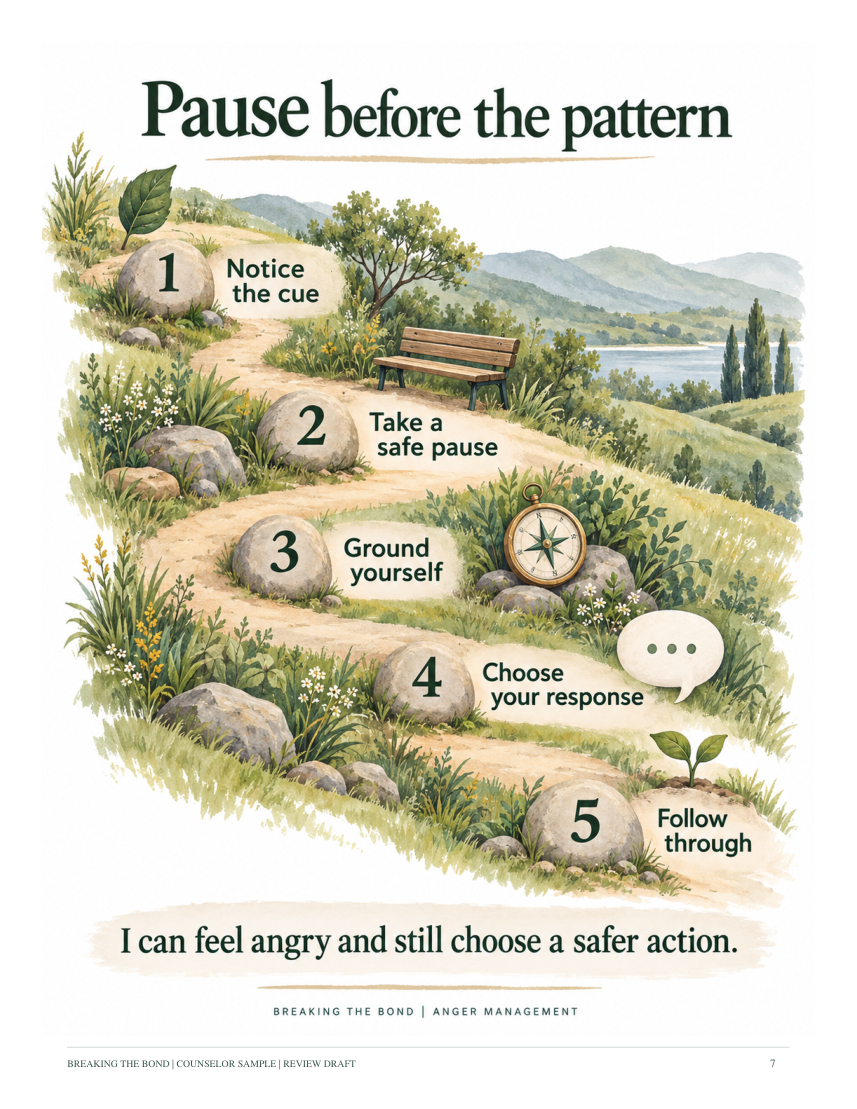
VISUAL: PAUSE BEFORE THE PATTERN
1. Notice the cue
2. Take a safe pause
3. Ground yourself
4. Choose your response
5. Follow through
I can feel angry and still choose a safer action.

VISUAL: BUILD YOUR COPING MENU
Feel support: notice the floor or chair beneath you.
Look around: name three things you can see.
Breathe comfortably: slow gently, without forcing.
Move gently: choose movement that works for you.
Write it down: separate the facts from the story.
Reach for support: use your support plan and a backup.
Choose what feels usable. Stop a skill if it increases distress.