Notice Anger Earlier
Recognize early cues, plan a safer pause, and choose a responsible next step.
View resource ↗Facilitator scripts, a low-stakes scenario, skill rehearsal, processing questions, and homework.
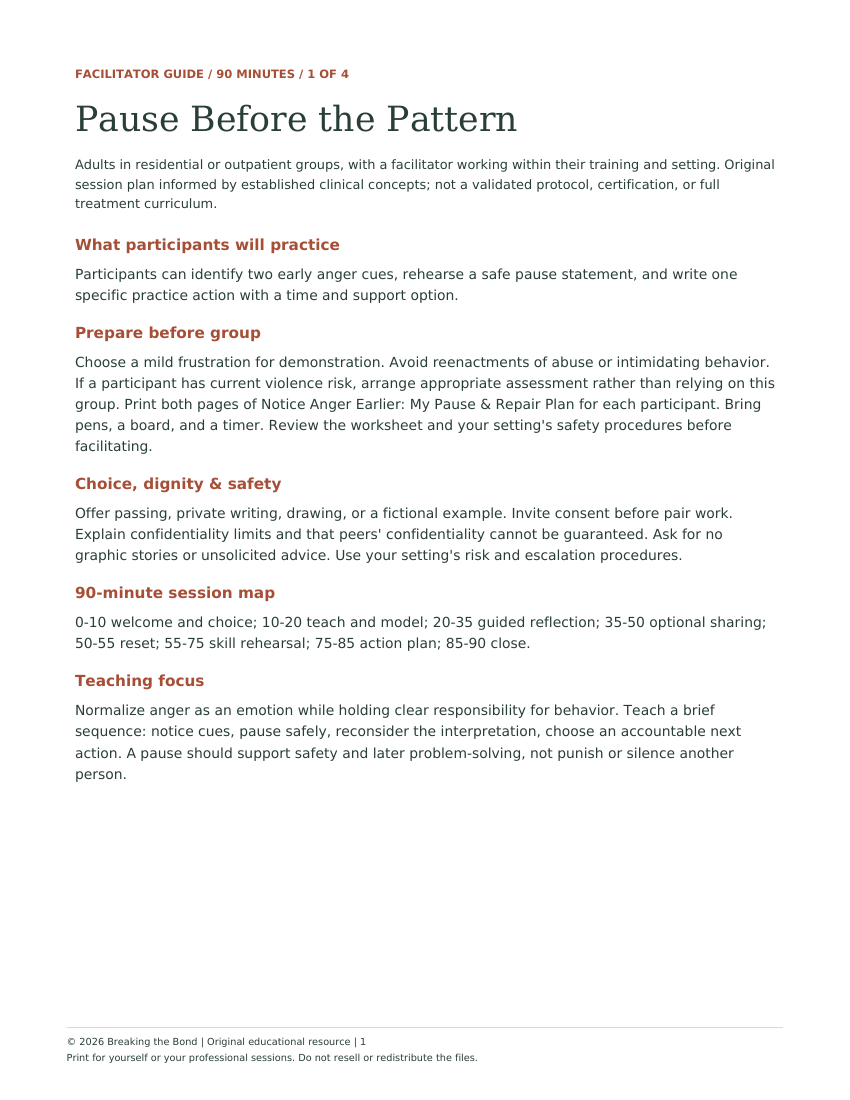
Actual first page · 4 printable US Letter pages in the complete PDF. These are printable files, not interactive fillable forms.
Print for personal use or your own professional sessions. Do not resell or redistribute the files. Educational content, not individualized treatment. Guides are original session plans, not validated protocols.
Need another format? ↗PAGE 1 © 2026 Breaking the Bond | Original educational resource | 1 Print for yourself or your professional sessions. Do not resell or redistribute the files. FACILITATOR GUIDE / 90 MINUTES / 1 OF 4 Pause Before the Pattern Adults in residential or outpatient groups, with a facilitator working within their training and setting. Original session plan informed by established clinical concepts; not a validated protocol, certification, or full treatment curriculum. What participants will practice Participants can identify two early anger cues, rehearse a safe pause statement, and write one specific practice action with a time and support option. Prepare before group Choose a mild frustration for demonstration. Avoid reenactments of abuse or intimidating behavior. If a participant has current violence risk, arrange appropriate assessment rather than relying on this group. Print both pages of Notice Anger Earlier: My Pause & Repair Plan for each participant. Bring pens, a board, and a timer. Review the worksheet and your setting's safety procedures before facilitating. Choice, dignity & safety Offer passing, private writing, drawing, or a fictional example. Invite consent before pair work. Explain confidentiality limits and that peers' confidentiality cannot be guaranteed. Ask for no graphic stories or unsolicited advice. Use your setting's risk and escalation procedures. 90-minute session map 0-10 welcome and choice; 10-20 teach and model; 20-35 guided reflection; 35-50 optional sharing; 50-55 reset; 55-75 skill rehearsal; 75-85 action plan; 85-90 close. Teaching focus Normalize anger as an emotion while holding clear responsibility for behavior. Teach a brief sequence: notice cues, pause safely, reconsider the interpretation, choose an accountable next action. A pause should support safety and later problem-solving, not punish or silence another person. PAGE 2 © 2026 Breaking the Bond | Original educational resource | 2 Print for yourself or your professional sessions. Do not resell or redistribute the files. FACILITATOR GUIDE / 90 MINUTES / 2 OF 4 Open, Teach & Explore Use the timing as a guide. Adapt the delivery to access needs while protecting practice time. 0-10 / Welcome and establish choice Say: "Today we will look for the moment before a reaction. You can use an everyday example, write privately, or pass." Review agreements. Ask: "What would make this conversation useful and manageable?" Invite a one-word check-in without requiring a personal story. 10-20 / Teach and model Write four headings: event, cues, interpretation, response. Model: a shared task is left unfinished; shoulders tighten; the thought is "They do not care"; the urge is to snap. Ask: "What is observable, and what is a guess?" Add an alternative explanation without insisting that it is true. 20-35 / Worksheet page 1 Give 7 minutes for sections 1-4, reading prompts aloud if helpful. Circulate without looking over shoulders. Ask permission before helping. If someone says "I just explode," ask: "What could a camera notice one moment earlier?" Allow a fictional example. Invite one alternative interpretation. 35-50 / Process without debating Offer pairs or private reflection for 5 minutes, then invite group observations. Ask: "Which early cue could give you time to act? What does anger signal that matters to you?" Reflect the need without approving threats or harm. If blame takes over, return to the participant's controllable response. PAGE 3 © 2026 Breaking the Bond | Original educational resource | 3 Print for yourself or your professional sessions. Do not resell or redistribute the files. FACILITATOR GUIDE / 90 MINUTES / 3 OF 4 Practice, Plan & Close Rehearsal is optional. Observe the skill rather than rating the person. 50-55 / Reset Offer water, quiet, or an optional seated stretch. Do not require closed eyes or breathing exercises. Check privately with anyone showing distress and follow your setting's procedures. 55-75 / Worksheet page 2 and rehearsal Allow 5 minutes for sections 5-7. Model a pause statement with a safe check-back plan. In pairs, each willing speaker practices for 2 minutes, followed by 1 minute of feedback; switch roles. The listener stays neutral and does not provoke. Use remaining time to discuss safe return, accountability, and respecting no-contact boundaries. 75-85 / Make the action specific Complete section 8: one cue, one response, one practice time. Ask: "How confident are you, 0-10? What would make this more doable?" If confidence is low, invite a smaller step. Check that the plan follows program rules and does not depend on another person changing. 85-90 / Close Invite one takeaway or a pass. Say: "Feeling anger does not remove your choices or responsibility. Practice helps us notice a possible choice sooner." Review homework and how to reach staff or support if distress rises. Optional practice scenario A roommate leaves dishes in a shared area. The speaker notices jaw tension and wants to criticize them. Practice a brief pause, then an appropriate request about the shared task. Do not use an active abusive relationship for rehearsal. Feedback prompts Ask: "Was the cue clear? Was the pause safe and respectful? Was the next action within the speaker's control?" Avoid voting on who was right. If harm has occurred, repair requires responsibility and respect for the other person's boundaries; an apology does not require forgiveness. PAGE 4 © 2026 Breaking the Bond | Original educational resource | 4 Print for yourself or your professional sessions. Do not resell or redistribute the files. FACILITATOR GUIDE / 90 MINUTES / 4 OF 4 Carry the Skill Forward Use clinical judgment. This resource supports, rather than replaces, individualized assessment and treatment. Homework & next-session review On one manageable occasion before the next session, note the cue, intensity, action, and outcome. Review what was learned, even if the plan was not used. Ask: "What might help you notice it earlier next time?" Adaptations & stuck points For low literacy, draw a body outline and circle cues. For shame, distinguish a harmful action from a global identity label. For escalating agitation, stop the exercise, create space, involve staff, and follow protocol. This is not a substitute for violence assessment or specialized intervention for coercive control. Facilitator review & documentation Check whether willing participants named two cues and rehearsed a pause. Note the specific next action and any requested support. Document observable participation and skill practice under your setting's requirements; do not document improvement that was not observed. Clinical background & further reading These original prompts and activities are not copied from the listed worksheets or manuals. Source organizations have not endorsed this resource. Links checked October 30, 2026. SAMHSA (2019). Anger Management for Substance Use Disorder and Mental Health Clients: A Cognitive-Behavioral Therapy Manual. https://library.samhsa.gov/sites/default/files/anger_management_manual_508_compliant.pdf
Recognize early cues, plan a safer pause, and choose a responsible next step.
View resource ↗