Daily Check-In
Pause, name what you’re feeling, identify a need, and choose one kind next step.
View resource ↗Bring all three worksheets into one adult group with timed activities, discussion prompts, and homework.
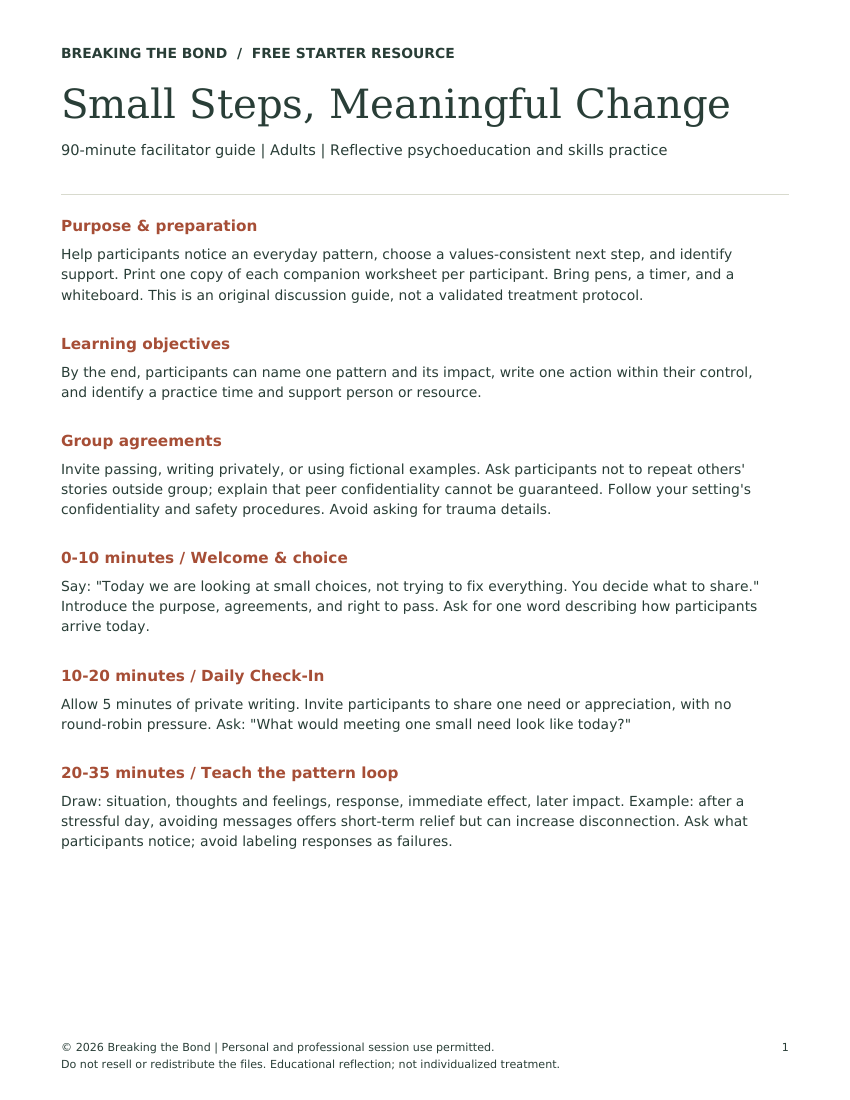
Actual first page · 2 printable US Letter pages in the complete PDF. These are printable files, not interactive fillable forms.
Print for personal use or your own professional sessions. Do not resell or redistribute the files. Educational content, not individualized treatment. Guides are original session plans, not validated protocols.
Need another format? ↗PAGE 1 BREAKING THE BOND / FREE STARTER RESOURCE Small Steps, Meaningful Change 90-minute facilitator guide | Adults | Reflective psychoeducation and skills practice © 2026 Breaking the Bond | Personal and professional session use permitted. Do not resell or redistribute the files. Educational reflection; not individualized treatment. 1 Purpose & preparation Help participants notice an everyday pattern, choose a values-consistent next step, and identify support. Print one copy of each companion worksheet per participant. Bring pens, a timer, and a whiteboard. This is an original discussion guide, not a validated treatment protocol. Learning objectives By the end, participants can name one pattern and its impact, write one action within their control, and identify a practice time and support person or resource. Group agreements Invite passing, writing privately, or using fictional examples. Ask participants not to repeat others' stories outside group; explain that peer confidentiality cannot be guaranteed. Follow your setting's confidentiality and safety procedures. Avoid asking for trauma details. 0-10 minutes / Welcome & choice Say: "Today we are looking at small choices, not trying to fix everything. You decide what to share." Introduce the purpose, agreements, and right to pass. Ask for one word describing how participants arrive today. 10-20 minutes / Daily Check-In Allow 5 minutes of private writing. Invite participants to share one need or appreciation, with no round-robin pressure. Ask: "What would meeting one small need look like today?" 20-35 minutes / Teach the pattern loop Draw: situation, thoughts and feelings, response, immediate effect, later impact. Example: after a stressful day, avoiding messages offers short-term relief but can increase disconnection. Ask what participants notice; avoid labeling responses as failures. PAGE 2 BREAKING THE BOND / FREE STARTER RESOURCE Facilitation & Follow-Through Small Steps, Meaningful Change | Continued © 2026 Breaking the Bond | Personal and professional session use permitted. Do not resell or redistribute the files. Educational reflection; not individualized treatment. 2 35-50 minutes / My Pattern & Next Step Allow 8 minutes of writing, then invite pairs or private reflection. Ask: "What does this response do for you right away? What does it cost later? What feels possible to try?" Reflect strengths and let participants choose their own target. 50-55 minutes / Brief reset Offer a seated stretch, water, or quiet pause. Keep eyes-open options available and do not require breathwork or movement. 55-70 minutes / Boundaries in Practice Introduce a boundary as a statement of your own limits and actions. Use the worksheet with a low-stakes scenario, such as declining an extra task. Offer optional paired practice; the listener acknowledges the statement without challenging it. Ask: "Was the action within your control?" 70-83 minutes / Build a practice plan Ask participants to finish: "When ___ happens, I will ___. I will practice by ___. My support is ___." Ask confidence from 0 to 10. If confidence is low, invite a smaller step or more support. Do not pressure anyone to raise a score. 83-90 minutes / Close & homework Invite one takeaway or a pass. Homework: try the chosen step once before the next session and note the situation, what you tried, what happened, and what you would adjust. At follow-up, discuss learning rather than success or failure. Facilitator notes & adaptations For low literacy, read prompts aloud or offer verbal responses and simple drawings. For distress, pause the activity, offer privacy and support, and use your setting's procedures. If acute risk is disclosed, stop the exercise and follow the appropriate safety protocol. Do not use the worksheet as a risk assessment. Review after the group Record participation and skill practice according to your setting's requirements. Ask: Was choice respected? Did each willing participant leave with a specific action? What needs adapting next time?
Pause, name what you’re feeling, identify a need, and choose one kind next step.
View resource ↗Explore what happens before an everyday pattern, its impact, and a manageable alternative.
View resource ↗Clarify a limit, focus on what you control, and practice putting it into words.
View resource ↗