A Fairer View of Myself
Separate a self-label from the facts and turn one personal value into a small action.
View resource ↗Practice believable self-talk with guided reflection, optional pairs, and a values-based action plan.
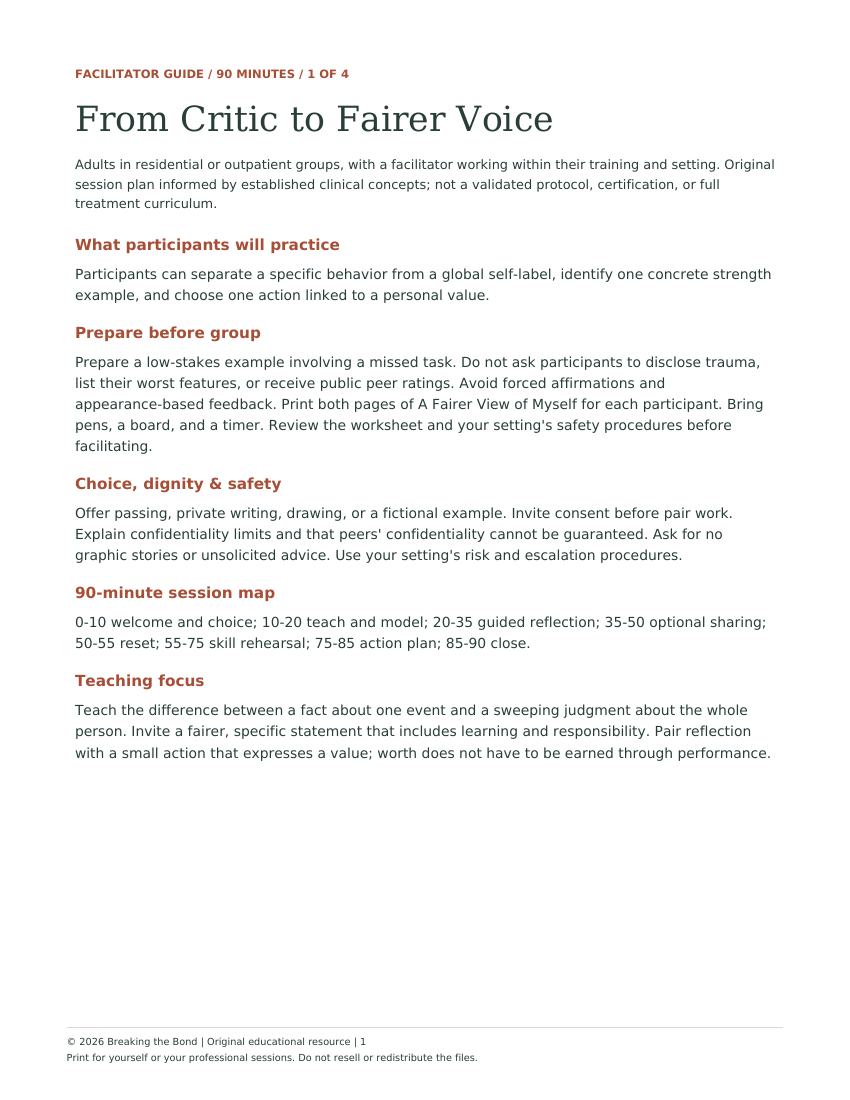
Actual first page · 4 printable US Letter pages in the complete PDF. These are printable files, not interactive fillable forms.
Print for personal use or your own professional sessions. Do not resell or redistribute the files. Educational content, not individualized treatment. Guides are original session plans, not validated protocols.
Need another format? ↗PAGE 1 © 2026 Breaking the Bond | Original educational resource | 1 Print for yourself or your professional sessions. Do not resell or redistribute the files. FACILITATOR GUIDE / 90 MINUTES / 1 OF 4 From Critic to Fairer Voice Adults in residential or outpatient groups, with a facilitator working within their training and setting. Original session plan informed by established clinical concepts; not a validated protocol, certification, or full treatment curriculum. What participants will practice Participants can separate a specific behavior from a global self-label, identify one concrete strength example, and choose one action linked to a personal value. Prepare before group Prepare a low-stakes example involving a missed task. Do not ask participants to disclose trauma, list their worst features, or receive public peer ratings. Avoid forced affirmations and appearance-based feedback. Print both pages of A Fairer View of Myself for each participant. Bring pens, a board, and a timer. Review the worksheet and your setting's safety procedures before facilitating. Choice, dignity & safety Offer passing, private writing, drawing, or a fictional example. Invite consent before pair work. Explain confidentiality limits and that peers' confidentiality cannot be guaranteed. Ask for no graphic stories or unsolicited advice. Use your setting's risk and escalation procedures. 90-minute session map 0-10 welcome and choice; 10-20 teach and model; 20-35 guided reflection; 35-50 optional sharing; 50-55 reset; 55-75 skill rehearsal; 75-85 action plan; 85-90 close. Teaching focus Teach the difference between a fact about one event and a sweeping judgment about the whole person. Invite a fairer, specific statement that includes learning and responsibility. Pair reflection with a small action that expresses a value; worth does not have to be earned through performance. PAGE 2 © 2026 Breaking the Bond | Original educational resource | 2 Print for yourself or your professional sessions. Do not resell or redistribute the files. FACILITATOR GUIDE / 90 MINUTES / 2 OF 4 Open, Teach & Explore Use the timing as a guide. Adapt the delivery to access needs while protecting practice time. 0-10 / Welcome and choice Say: "We are not going to force positive thinking. We will practice describing ourselves more fairly." Review agreements and the option to use a fictional example. Ask: "What helps you feel respected in a group?" Use responses to reinforce choice and listening. 10-20 / Teach with a neutral example Write: "I missed a scheduled task" and "I ruin everything." Ask: "Which describes an event, and which labels a whole person?" Invite a fairer version, such as "I missed one task and can set a reminder." Keep accountability visible without treating shame as a requirement for change. 20-35 / Worksheet page 1 Give 8 minutes for sections 1-4. Ask participants to choose a mild example and use exact words only if comfortable. Offer: "What facts fit the concern? What facts do not fit the whole-person label?" If no alternative feels believable, try "I am learning to..." with a specific action rather than insisting on praise. 35-50 / Process with permission Offer pairs, a quiet written exchange, or continued private work. Invite sharing of a fairer statement, not the original insult. Ask: "What changed when the statement became more specific? What responsibility remains?" Reflect effort and clarity. Do not let peers argue someone into feeling worthy. PAGE 3 © 2026 Breaking the Bond | Original educational resource | 3 Print for yourself or your professional sessions. Do not resell or redistribute the files. FACILITATOR GUIDE / 90 MINUTES / 3 OF 4 Practice, Plan & Close Rehearsal is optional. Observe the skill rather than rating the person. 50-55 / Reset Offer water or a quiet pause. Let participants keep eyes open and choose whether to move. Check with anyone who wants support without asking them to explain their distress publicly. 55-75 / Worksheet page 2 and skill practice Spend 5 minutes on sections 5-6. Model a quality with evidence: "I value reliability; I called to reschedule instead of disappearing." Invite willing pairs to practice responding to a fictional self-judgment with a fairer statement. Give each speaker 2 minutes and each listener 1 minute of feedback; switch, then debrief. No advice or compliments are required. 75-85 / Choose a values action Use section 7. Ask: "What matters enough to take a small step? When will you try it? What is your backup?" Invite a confidence rating of 0-10 and a smaller action if needed. Emphasize that completing the action is practice, not proof of worth. Section 8 is for review after trying it. 85-90 / Close Invite one useful phrase or a pass. Say: "A fairer view can hold difficulty, responsibility, and possibility at the same time." Explain homework and invite participants to speak with staff if the exercise brings up more than they want to manage alone. Optional practice scenario Jordan forgets to reply to a friend and thinks, "I am a terrible person." Practice a statement that acknowledges the missed reply without a global label. Then choose a value-based action, such as sending a respectful check-in, without demanding a particular response. Feedback prompts Ask: "Was the new statement specific, believable, and fair? Did it acknowledge the event? Is the action connected to a value?" Avoid reassurance contests, rating attractiveness, or comparing participants' achievements. PAGE 4 © 2026 Breaking the Bond | Original educational resource | 4 Print for yourself or your professional sessions. Do not resell or redistribute the files. FACILITATOR GUIDE / 90 MINUTES / 4 OF 4 Carry the Skill Forward Use clinical judgment. This resource supports, rather than replaces, individualized assessment and treatment. Homework & next-session review Before the next session, record one self-judgment and one fairer response. Try the chosen values action once, then finish section 8. At follow-up, ask about learning and barriers, not whether confidence or mood improved. Adaptations & stuck points Allow drawing, dictation, or a fictional character for participants who struggle to name strengths. Ask about an action they took, rather than demanding a positive trait. If trauma or acute risk is disclosed, stop public processing, offer individual support, and follow your setting's procedures. Facilitator review & documentation Check whether participants distinguished a fact from a label, named evidence for a quality, and wrote a doable action. Do not score self-worth or imply this session treats a diagnosed condition. Document observable participation and skill practice under your setting's requirements; do not document improvement that was not observed. Clinical background & further reading These original prompts and activities are not copied from the listed worksheets or manuals. Source organizations have not endorsed this resource. Links checked October 30, 2026. Centre for Clinical Interventions, WA Health. Improving Self-Esteem: modules and clinical resources. https://www.cci.health.wa.gov.au/Resources/Looking-After-Yourself/Self-Esteem
Separate a self-label from the facts and turn one personal value into a small action.
View resource ↗