My Recovery Response Plan
Identify personal risk situations, write a first response and backup, and plan support.
View resource ↗Lead recovery planning with rehearsal, accessible support options, homework, and medical safety notes.
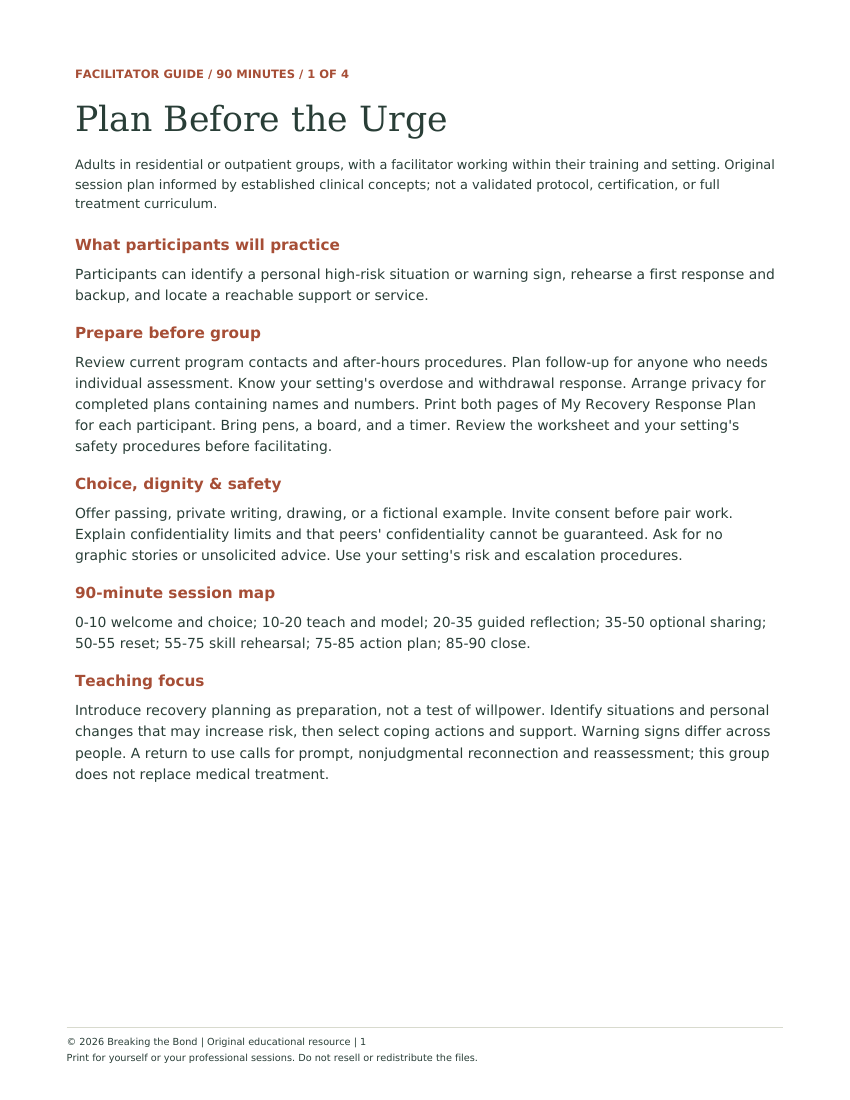
Actual first page · 4 printable US Letter pages in the complete PDF. These are printable files, not interactive fillable forms.
Print for personal use or your own professional sessions. Do not resell or redistribute the files. Educational content, not individualized treatment. Guides are original session plans, not validated protocols.
Need another format? ↗PAGE 1 © 2026 Breaking the Bond | Original educational resource | 1 Print for yourself or your professional sessions. Do not resell or redistribute the files. FACILITATOR GUIDE / 90 MINUTES / 1 OF 4 Plan Before the Urge Adults in residential or outpatient groups, with a facilitator working within their training and setting. Original session plan informed by established clinical concepts; not a validated protocol, certification, or full treatment curriculum. What participants will practice Participants can identify a personal high-risk situation or warning sign, rehearse a first response and backup, and locate a reachable support or service. Prepare before group Review current program contacts and after-hours procedures. Plan follow-up for anyone who needs individual assessment. Know your setting's overdose and withdrawal response. Arrange privacy for completed plans containing names and numbers. Print both pages of My Recovery Response Plan for each participant. Bring pens, a board, and a timer. Review the worksheet and your setting's safety procedures before facilitating. Choice, dignity & safety Offer passing, private writing, drawing, or a fictional example. Invite consent before pair work. Explain confidentiality limits and that peers' confidentiality cannot be guaranteed. Ask for no graphic stories or unsolicited advice. Use your setting's risk and escalation procedures. 90-minute session map 0-10 welcome and choice; 10-20 teach and model; 20-35 guided reflection; 35-50 optional sharing; 50-55 reset; 55-75 skill rehearsal; 75-85 action plan; 85-90 close. Teaching focus Introduce recovery planning as preparation, not a test of willpower. Identify situations and personal changes that may increase risk, then select coping actions and support. Warning signs differ across people. A return to use calls for prompt, nonjudgmental reconnection and reassessment; this group does not replace medical treatment. PAGE 2 © 2026 Breaking the Bond | Original educational resource | 2 Print for yourself or your professional sessions. Do not resell or redistribute the files. FACILITATOR GUIDE / 90 MINUTES / 2 OF 4 Open, Teach & Explore Use the timing as a guide. Adapt the delivery to access needs while protecting practice time. 0-10 / Welcome and choice Say: "We are planning for support before things get harder. You choose how much to share." Review group agreements and avoid graphic use stories. Ask: "What is one thing you want recovery to make room for?" Reflect the participant's own reason without persuading or labeling. 10-20 / Teach and model Draw three headings: situation, first action, backup. Use a fictional person who feels isolated after a stressful day and misses a support call. Ask: "What could make the next hour safer and more connected?" Model contacting a support person and using a reachable backup rather than relying on a promise never to struggle. 20-35 / Worksheet page 1 Allow 8 minutes for sections 1-4. Ask participants to choose a likely situation, not their most distressing memory. Prompt: "What can you notice? What action fits your setting? What if that action is not enough?" In residential care, a staff request may be the appropriate first response. 35-50 / Process and troubleshoot Offer optional pairs or private reflection. Ask: "Is the plan possible at the time and place you need it? What could get in the way?" Explore transport, phone access, privacy, cost, and staff availability. Invite alternatives without assuming everyone has family support or wants the same recovery pathway. PAGE 3 © 2026 Breaking the Bond | Original educational resource | 3 Print for yourself or your professional sessions. Do not resell or redistribute the files. FACILITATOR GUIDE / 90 MINUTES / 3 OF 4 Practice, Plan & Close Rehearsal is optional. Observe the skill rather than rating the person. 50-55 / Reset Offer water or quiet. If someone reports current intoxication, concerning withdrawal, imminent use with immediate risk, or other acute danger, pause group participation and arrange assessment under program procedures. Do not treat skill practice as the response to a medical emergency. 55-75 / Worksheet page 2 and rehearsal Spend 5 minutes on sections 5-6. Practice a support request: "I am having a hard time and need help with my plan." Each willing speaker rehearses a first contact and a backup, then switch. Peers do not promise crisis availability. Briefly review the worksheet's medical safety box and identify who provides individualized overdose prevention and medication support. 75-85 / Make the plan reachable Complete section 7 and check that at least one contact or service is realistic; follow up individually if it is not. Ask confidence from 0-10 and invite an adjustment. Have participants identify where they will keep their plan privately. Choose a review date with the care team. 85-90 / Close and reconnect Invite one next action or a pass. Say: "You can ask for help before, during, or after a difficult moment. A return to use is a reason to reconnect promptly." Explain homework, verified program contacts, and the route to staff or medical care after group. Optional practice scenario Alex has an evening alone, feels lonely, and has started avoiding recovery contacts. Their first support person may be unavailable. Rehearse a short request, a second contact or staffed service, and a safe action while seeking help. Adapt the situation to the participant's own plan. Feedback prompts Ask: "Is the first step specific? Is the backup reachable? Does the plan include treatment support?" Do not stage exposure to substances, pressure people to describe use, or promise that a coping technique will prevent every recurrence. PAGE 4 © 2026 Breaking the Bond | Original educational resource | 4 Print for yourself or your professional sessions. Do not resell or redistribute the files. FACILITATOR GUIDE / 90 MINUTES / 4 OF 4 Carry the Skill Forward Use clinical judgment. This resource supports, rather than replaces, individualized assessment and treatment. Homework & next-session review Within 24 hours, take one agreed support action and check one contact or service with the care team. Review which part was usable and what needs changing. If use occurs, reconnect promptly for assessment and a revised plan rather than waiting for the next group. Adaptations & stuck points Use icons for situation, action, and support when reading is difficult. Do not assume phones, safe housing, mutual-help participation, or abstinence-only treatment. Respect individualized goals and prescribed medications. For suspected overdose or severe withdrawal, activate medical procedures; a worksheet is not a detox plan. Facilitator review & documentation Check for a first response, backup, and reachable support. Note needed follow-up without collecting private contact details in shared group materials. Document observable participation and skill practice under your setting's requirements; do not document improvement that was not observed. Clinical background & further reading These original prompts and activities are not copied from the listed worksheets or manuals. Source organizations have not endorsed this resource. Links checked October 30, 2026. SAMHSA (2019). TIP 35, Chapter 7: From Action to Maintenance: Stabilizing Change. https://www.ncbi.nlm.nih.gov/books/NBK571075/ CDC. Risks and How to Reduce Them. https://www.cdc.gov/overdose-prevention/manage-treat-pain/reduce-risks.html CDC (2024). What to Do If You Think Someone Is Overdosing. https://www.cdc.gov/stop-overdose/response/
Identify personal risk situations, write a first response and backup, and plan support.
View resource ↗